

Medically reviewed by Shariff K. Bishai, DO, MS
I am careful about recommending subacromial decompression because the question is not simply whether I can perform the procedure. It is whether the procedure is likely to help a particular patient. Our understanding of shoulder impingement and the role of decompression has changed considerably over the years, and I think patients deserve an honest explanation of what the surgery can and cannot accomplish. When I discuss subacromial decompression surgery for impingement with a patient, I focus less on the mechanics of the operation and more on why it may or may not make sense for their shoulder.
Key Takeaways
- Subacromial decompression creates more room in the space beneath the acromion. Surgeons shave down bone spurs and remove inflamed bursal tissue to do it.
- It is performed arthroscopically through small incisions, usually as an outpatient procedure. It is frequently combined with another repair rather than done by itself.
- Recent research raised real questions about how much benefit decompression alone provides for shoulder pain without a structural tear.
What the Subacromial Space Is
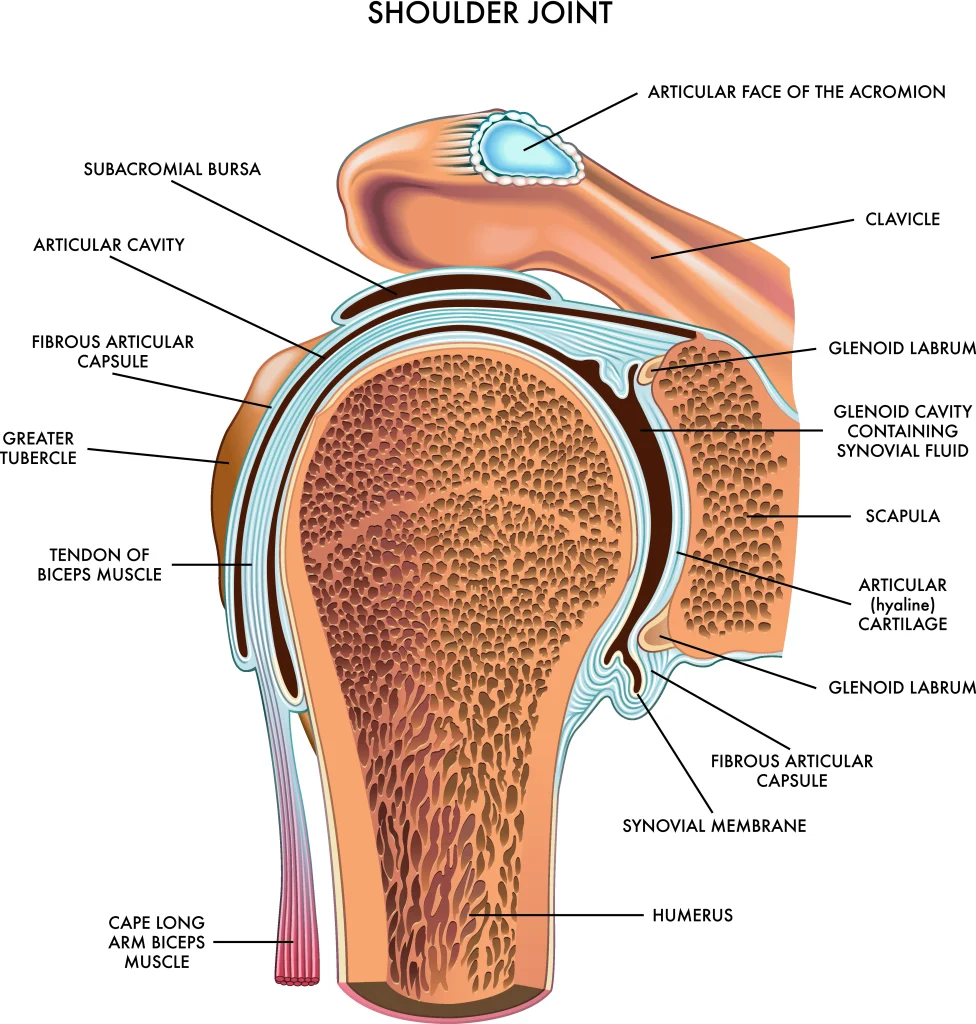
Picture the top of your shoulder. The acromion is the bony shelf that projects off the shoulder blade and forms the roof over the joint. Underneath it, in a gap only a few millimeters tall, run the rotator cuff tendons and a fluid-filled cushion called the subacromial bursa. Every time you raise your arm, those tendons slide through that gap.
Problems start when the gap narrows or the contents swell. A bone spur can grow off the underside of the acromion. Some people are simply born with a more hooked acromion that leaves less clearance. The bursa can thicken from years of overhead work. Any of these can produce the classic complaints of shoulder impingement syndrome: pinching, a painful arc partway through raising the arm, and pain at night.
Impingement is a description of a mechanical situation. It is not a single disease with a single fix. Two shoulders can produce the same painful arc for genuinely different reasons.
What Happens During Subacromial Decompression
The procedure is done arthroscopically. I make several small incisions, insert a camera, and work through instruments passed through the other portals. The first step is usually a look around the joint itself, because what I find inside frequently affects what I do next.
In the subacromial space, the work has two parts. Inflamed, thickened bursal tissue gets removed, which is called a bursectomy. Then any bone spur on the undersurface of the acromion gets shaved down with a burr, which is the acromioplasty. Together these open up the space the tendons travel through. Some surgeons also address the coracoacromial ligament depending on what they find.
Most patients go home the same day. The incisions are small enough that they typically close with a stitch or two. I perform these procedures at surgical facilities in the Detroit area, and the outpatient setting suits this operation well.
How the Evidence Changed the Conversation
For a long stretch, subacromial decompression was close to a reflex response to stubborn shoulder pain. Then two large randomized trials published in 2018 complicated the picture. One compared arthroscopic decompression against a placebo arthroscopy, where surgeons looked inside but removed nothing. The other compared it against a diagnostic arthroscopy and against supervised exercise therapy. Patients across all the groups improved. The decompression groups did not separate meaningfully from the comparison groups.
Those results did not make the operation useless. What they did was narrow the population it makes sense for. The current standard leans hard toward exhausting non-surgical care first, then reserving decompression for well-defined situations rather than offering it broadly.
My view is that the trials did the field a favor. I would rather have this conversation honestly than schedule an operation the evidence suggests may not move a patient’s pain much.
Who Tends to Be a Candidate
The patients I consider for decompression usually share a few features. They have completed a genuine course of conservative treatment. That means several months of structured physical therapy, not a few weeks of stretching at home. Their imaging shows a structural reason for the impingement, most often a defined bone spur or a hooked acromion crowding the space. Their exam and their history line up with what the imaging shows.
Decompression can also come up as part of a larger operation. When I am repairing a rotator cuff tear, I add it only when a specific spur or crowding is part of the problem. In that setting the decompression is a supporting step rather than the main event, and the recovery follows the rotator cuff surgery recovery timeline rather than a decompression timeline.
The patients I steer away from surgery are the ones whose pain does not have a mechanical explanation, whose stiffness suggests the capsule rather than the bone, or who have not yet given therapy an honest run. Sending someone to the operating room to solve a problem the operation does not address helps nobody.
The AC Joint Question
The acromioclavicular joint sits at the very top of the shoulder, where the collarbone meets the acromion. It is a small joint, and it wears out in a lot of people by middle age. It also sits immediately next to everything a decompression addresses.
That proximity matters for two reasons. First, AC joint arthritis produces pain in almost the same region as impingement, and patients rarely distinguish the two. Point tenderness right on top of the shoulder, and pain reaching the arm across the body, tend to point at the AC joint instead. Second, when the AC joint is clearly involved, a distal clavicle excision is sometimes performed during the same arthroscopy. That step removes a small amount of bone from the collarbone end of the joint.
I do not add that step casually. Taking bone from a joint that is not the source of a patient’s pain adds recovery time and gains nothing. A diagnostic injection into the AC joint itself is usually how I settle the question.
What I See in My Patients
Troy and the surrounding suburbs send me a steady stream of impingement, and it clusters in recognizable groups. Tradespeople make up a large share of it. Electricians, painters, drywall finishers, and auto plant workers spend their days with hands above shoulder height. They tend to arrive in their forties and fifties with years of accumulated irritation. Their shoulders often respond well to activity modification and therapy. Modifying the activity gets complicated when the overhead work is the job.
The second group is recreational athletes. Swimmers, tennis players, and the weekend lifters who have been pressing overhead for two decades. Their symptoms usually build slowly. Their exam frequently shows a scapular mechanics problem sitting underneath the impingement, and that is something therapy can genuinely change.
The third group is the one that most often surprises people. Patients who were told years ago that they had a bone spur, saw it on an X-ray, and have carried around the belief that surgery is inevitable. A spur on a film is not a reason to operate. I have plenty of patients walking around Oakland County with spurs and no symptoms at all.
My Approach to Recommending Decompression
I start by trying to determine what is actually generating the pain, which sounds obvious and is frequently skipped. That means a careful exam, plain X-rays to look at the acromion and rule out arthritis, and an MRI when I need to see the tendons and the bursa. A diagnostic injection is one of the more useful tools I have, since meaningful relief from numbing the subacromial space tells me a lot about where the problem lives.
Then we do the conservative work properly. That means a therapy program targeting the rotator cuff and the muscles controlling the shoulder blade, not generic stretching. Anti-inflammatory medication where it fits. For the right patients, regenerative options such as PRP are worth discussing for stubborn tendon irritation.
If several months of that produces no durable change, and the structural picture supports it, decompression may become a reasonable next step. I tell patients what I expect it to fix and what it will not. It addresses mechanical crowding. It does not loosen a stiff capsule. It does not repair a torn tendon. It also will not undo the effects of going back to the same overhead work the same way afterward.
Recovery After Subacromial Decompression
When decompression is done on its own, recovery tends to be faster than most patients expect. A sling is generally used for comfort in the first days rather than for protection, and gentle motion typically starts early because there is no repaired tendon that needs to be protected. Formal therapy usually begins within the first week or two and focuses on restoring motion before adding strength.
Most patients return to desk work within a couple of weeks. Overhead work and overhead sport take considerably longer, often several months. The shoulder frequently keeps improving well past the point when the incisions have healed. Soreness that lingers for a few months is common and does not mean something went wrong.
The patients who do best after a decompression treat rehabilitation as the second half of the procedure rather than an optional follow-up. I say that in the pre-operative visit, and I say it again at the first post-operative appointment.
Summary
Subacromial decompression opens up the space between the acromion and the rotator cuff tendons by removing bone spur and inflamed bursa, and it is done arthroscopically as a same-day procedure. The operation is well established and technically reliable. What has changed is the standard for who should have it, after trials showed that decompression alone did not outperform placebo surgery or structured exercise for general shoulder pain. It remains a sound option for carefully selected patients with a clear structural cause, and it is sometimes added to a larger repair when a specific spur is part of the problem.
If you have been told you need a decompression, the most useful question to bring to your consultation is a simple one: what specifically on my exam and my imaging makes this the right operation for me? If your shoulder pain has not improved after several months of therapy, you can request an appointment at my Troy office and bring any prior imaging with you. Having the films in hand often shortens the path to a real answer.
Frequently Asked Questions
Is subacromial decompression the same as rotator cuff surgery?
No, though the two are often performed together. Decompression removes bone and inflamed tissue to create more room in the subacromial space. Rotator cuff repair reattaches a torn tendon to bone. A shoulder can need one, the other, or both, and the recovery differs considerably depending on which was done. If you are unsure which procedure you had, the operative report will say.
How long does the surgery take?
An isolated arthroscopic decompression is usually a relatively short procedure, often under an hour of actual operative time, though the full time in the surgical facility including anesthesia and recovery runs longer. When additional work is done in the same setting, the operative time increases accordingly.
What happens if I do nothing?
Impingement symptoms sometimes settle with rest and activity changes and sometimes persist. The concern with leaving it alone indefinitely is that ongoing mechanical irritation may contribute to tendon wear over time in some patients, and a partial tear may progress. That risk varies quite a bit between patients, which is part of why the decision deserves an individual conversation rather than a general rule.