


Medically reviewed by Shariff K. Bishai, DO, MS | Reviewed May 2026
If you have been dealing with shoulder pain that flares up every time you reach overhead, grab something off a shelf, or tuck your arm behind your back, shoulder impingement syndrome may be what is going on. So, what is shoulder impingement syndrome? It is one of the most common causes of shoulder pain that I see at the Detroit Orthopaedic Institute, and it can affect people of all ages and activity levels. Whether you are an overhead athlete or someone who noticed a nagging ache that has been slowly getting worse, understanding this condition, and knowing what can be done about it, may help you take the right next step toward relief.
Key Takeaways
- Shoulder impingement syndrome occurs when the rotator cuff tendons become irritated or compressed as they pass beneath the acromion, the bony prominence at the top of the shoulder blade.
- Common contributing factors may include repetitive overhead activity, muscle imbalances, certain structural features of the shoulder, and age-related changes to the tendons or bone.
- Many patients with shoulder impingement syndrome respond well to conservative treatment, including physical therapy, activity modification, and anti-inflammatory medications.
- If non-surgical approaches do not provide adequate relief, arthroscopic procedures may be an option.
What Is Shoulder Impingement Syndrome?
The shoulder is one of the most mobile joints in the body. It is designed to move in nearly every direction, which makes it remarkably functional but also somewhat vulnerable when the careful balance of structures around it gets disrupted.
At the top of the shoulder blade sits a bony overhang called the acromion. Beneath it runs the subacromial space, a relatively narrow corridor through which the rotator cuff tendons and a small fluid-filled cushion called the bursa must pass every time the arm moves. Under normal circumstances, there is enough clearance for these structures to glide smoothly without friction or irritation.
When the tendons or bursa become irritated, swollen, or mechanically crowded, they begin to rub against the underside of the acromion during arm movement. That repeated contact is what we call impingement. Over time, the friction generates inflammation, and the bursa, designed to protect the tendons, can become inflamed and swollen as well. This is known as bursitis, and it often develops alongside impingement.
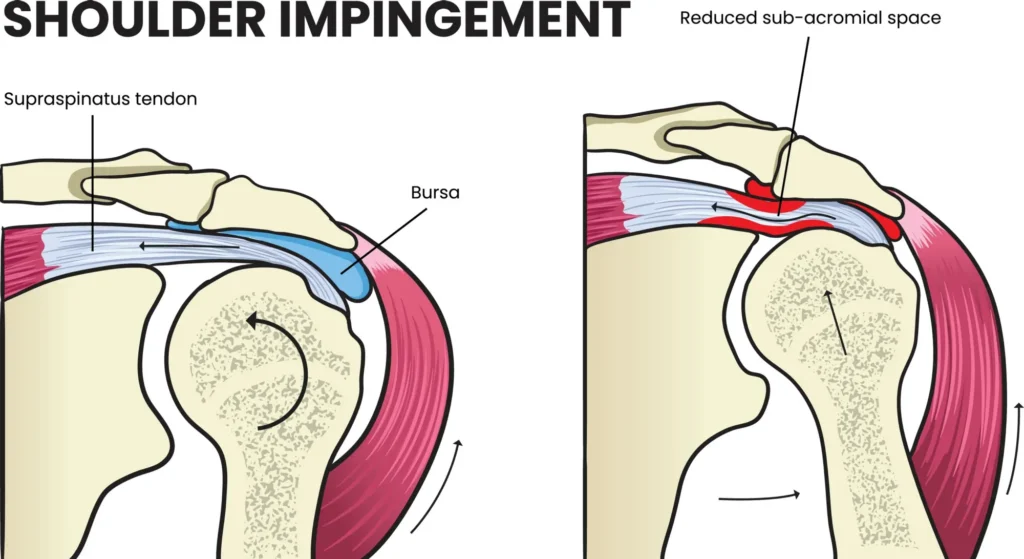
What starts as occasional discomfort can gradually become more disruptive, interfering with sleep, work, or activities you enjoy. Left unaddressed, the ongoing irritation may also contribute to tendon damage over time, which is why getting an accurate diagnosis and appropriate treatment matters.
What Causes Shoulder Impingement Syndrome?
In many cases, shoulder impingement syndrome does not result from a single event. It tends to develop from a combination of factors that place ongoing stress on the subacromial region. Some of the most common contributors I see include:
Repetitive overhead activity. Jobs and sports that involve repeated arm elevation (swimming, baseball, painting, volleyball, certain trades) can gradually irritate the tendons and bursa. Over time, the cumulative strain adds up.
Muscle imbalances and posture. When the muscles around the shoulder and upper back are weak or unbalanced, the mechanics of the joint can shift. This may allow the head of the humerus to migrate slightly upward within the socket, effectively narrowing the space available for the tendons to move through. Rounded shoulders, forward head posture, and sedentary habits can all contribute.
Bone anatomy. Some people are born with an acromion that curves or hooks downward rather than sitting flat. This shape can reduce the clearance in the subacromial space, making tendon irritation more likely, even in patients who are not particularly active overhead. Bone spurs that develop on the underside of the acromion over time can have a similar effect.
Rotator cuff weakness or prior injury. When the rotator cuff muscles are weakened, they may struggle to keep the humeral head properly centered during movement. That subtle loss of control can allow more contact between the tendons and the acromion with every repetition.
Age-related changes. As we get older, the tendons naturally lose some elasticity. Bone spurs may accumulate. Both changes can reduce available subacromial space and make shoulder impingement syndrome more likely, even without a history of heavy overhead activity.
In my experience, understanding which specific factors are driving a patient’s symptoms is what allows us to build a treatment plan that actually addresses the problem rather than just managing it. That’s why I spend time on the evaluation before recommending any particular approach.
What Are the Symptoms of Shoulder Impingement Syndrome?
Symptoms of shoulder impingement syndrome may include:
- Pain with lifting the arm overhead or reaching forward and across the body
- Discomfort when reaching behind the back, such as fastening a seatbelt or tucking in a shirt
- A painful arc of motion, often occurring between approximately 60 and 120 degrees of arm elevation
- Night pain, particularly when sleeping on the affected side
Some patients also notice weakness or early fatigue with overhead tasks, or a sense of catching and sharp pain deep in the shoulder with certain movements. These symptoms can creep up gradually, which is part of why so many patients put off getting them evaluated.
Symptoms of shoulder impingement syndrome can overlap with other shoulder conditions, including rotator cuff tears, biceps tendinitis, and AC joint arthritis. A proper evaluation by a shoulder specialist is exactly how we sort that out. Treating the right problem makes all the difference in how well, and how quickly, patients recover.
How Is Shoulder Impingement Syndrome Diagnosed?
When a patient comes to see me with shoulder pain, I start with a detailed history. I want to understand when the pain began, what makes it worse, whether it developed gradually or followed a specific event, and what the patient has tried so far. The physical examination involves assessing shoulder range of motion, strength, and specific patterns of pain with certain movements.
Imaging may also be ordered. X-rays may reveal bone spurs, structural changes to the acromion, calcium deposits, or AC joint arthritis. If additional evaluation of the rotator cuff tendons or bursa is needed, MRI may help identify inflammation, tendon pathology, or a possible rotator cuff tear.
The goal of the diagnostic process is to understand why pain is occurring, so that treatment can be properly targeted.
Treatment Options for Shoulder Impingement Syndrome
Many patients with shoulder impingement syndrome respond well to non-surgical treatment. A thoughtful, progressive approach tends to work best.
Physical Therapy and Exercise
Physical therapy is frequently a treatment component for shoulder impingement syndrome. A skilled therapist can design a program focused on restoring normal shoulder mechanics, strengthening the rotator cuff and the muscles around the shoulder blade, and addressing posture and movement patterns that may be contributing to the problem. This is an active process that requires consistency and engagement. The more patients commit to their program, the better their results tend to be.
Activity Modification
Temporarily modifying activities that aggravate the shoulder may make a meaningful difference during the recovery period. This does not have to mean stopping everything. It means being thoughtful about which specific movements are adding to the inflammation and finding ways to protect the shoulder while it heals and strengthens.
Anti-Inflammatory Medications
Nonsteroidal anti-inflammatory drugs (NSAIDs) may help reduce pain and swelling enough to allow more productive participation in physical therapy. Your doctor can help determine whether these are appropriate for your specific health situation.
Corticosteroid Injections
For patients with more significant pain and inflammation, a corticosteroid injection into the subacromial bursa may provide meaningful temporary relief. This can be especially helpful when pain is preventing adequate participation in rehabilitation. Injections are generally not a standalone long-term solution, but they may serve as a useful bridge while the shoulder responds to therapy.
Regenerative Medicine
For certain patients, regenerative medicine options may be worth discussing as part of the overall plan. Platelet-rich plasma (PRP) therapy, for example, uses concentrated components of the patient’s own blood and aims to support the body’s natural healing response in and around the affected tendons.
When Surgery May Be Considered
Surgery is not usually where treatment starts for shoulder impingement syndrome, but it may become a reasonable conversation to have when conservative care has not produced adequate relief after several dedicated months of non-operative treatment.
The most common surgical approach is an arthroscopic subacromial decompression. Using small instruments inserted through tiny incisions, your surgeon can create more space within the subacromial region by smoothing bone spurs on the underside of the acromion and removing the inflamed bursa tissue that has been contributing to the compression. The goal of reducing mechanical pressure is to improve shoulder comfort and reduce ongoing irritation during movement. If a rotator cuff tear is found alongside the impingement, it may be possible to address both during the same arthroscopic procedure.
Summary
Shoulder impingement syndrome is a common shoulder condition. It develops when the rotator cuff tendons and bursa become irritated as they pass through the subacromial space beneath the acromion. Contributing factors may include repetitive overhead activity, muscle imbalances, the shape of the acromion, and age-related tendon changes. Symptoms may include pain with overhead and behind-the-back movements, night discomfort, and fatigue with use. Many patients experience meaningful improvement with physical therapy, activity modification, and anti-inflammatory treatment. For those who do not respond to non-surgical care, arthroscopic decompression may be considered.
If shoulder pain is limiting what you can do, the right place to start is scheduling a consultation. I would welcome the chance to help you understand what is going on and what options may make sense for your situation.
Frequently Asked Questions
Can shoulder impingement syndrome get worse over time if it is not treated?
It can, yes. Persistent impingement can lead to ongoing irritation and potential damage to the rotator cuff tendons over time. In some cases, persistent irritation and tendon degeneration may increase the likelihood of rotator cuff tearing over time. Getting ahead of the problem is always easier than managing advanced tendon damage. If you are in the Troy or Detroit area and dealing with shoulder pain that is not improving, I would encourage you to come in for an evaluation rather than waiting to see how things develop.
Is shoulder impingement syndrome the same as a rotator cuff tear?
No, these are related but distinct conditions. Shoulder impingement syndrome refers to the irritation and compression of the rotator cuff tendons and bursa within the subacromial space. A rotator cuff tear refers to actual structural damage to the tendon itself. The two conditions can coexist, but each has its own characteristics and may require different treatment.
Who is most at risk for developing shoulder impingement syndrome?
People who regularly perform repetitive overhead activities, such as swimmers, baseball or volleyball players, painters, or certain tradespeople, tend to be at higher risk. Those with weak rotator cuff muscles, poor posture, or a naturally curved acromion may also be more susceptible. That said, shoulder impingement syndrome can develop across a wide range of patients and does not exclusively affect athletes or those in physically demanding roles.