
Medically reviewed by Shariff K. Bishai, DO, MS | Reviewed June 2026
If there’s one thing I tell every patient before we schedule rotator cuff surgery recovery, it’s this: plan for a six-month commitment, not a six-week one. I’ve performed a lot of these repairs, and the patients who do best are the ones who go into it with realistic expectations and a genuine understanding of what each phase of recovery actually involves.
This post is my attempt to walk you through what recovery from rotator cuff surgery really looks like, week by week, phase by phase, so you know what’s coming before it arrives.
Key Takeaways
- Rotator cuff surgery recovery typically spans six months to a year, depending on tear size, repair type, and how consistently a patient follows their rehabilitation program.
- Most patients spend the first four to six weeks in a sling. Passive range-of-motion work tends to begin shortly after surgery, while active motion and strengthening come later.
- Physical therapy is not optional. The quality and consistency of your rehab is one of the biggest factors in your final outcome.
Why Rotator Cuff Surgery Recovery Takes as Long as It Does
Before we get into the week-by-week breakdown, I want to explain why recovery takes the time it does. I find that when patients understand the biology, they tend to be more patient with themselves.
When we perform an arthroscopic rotator cuff repair, we’re reattaching torn tendon back to bone. That’s not the same as healing a soft tissue bruise. Tendon-to-bone healing is a slow, structured biological process. The tendon goes through a predictable sequence of stages (inflammation, collagen deposition, and remodeling), and that process can’t be rushed without risking the repair. Moving too fast can pull the tendon away before it has securely integrated into the bone.
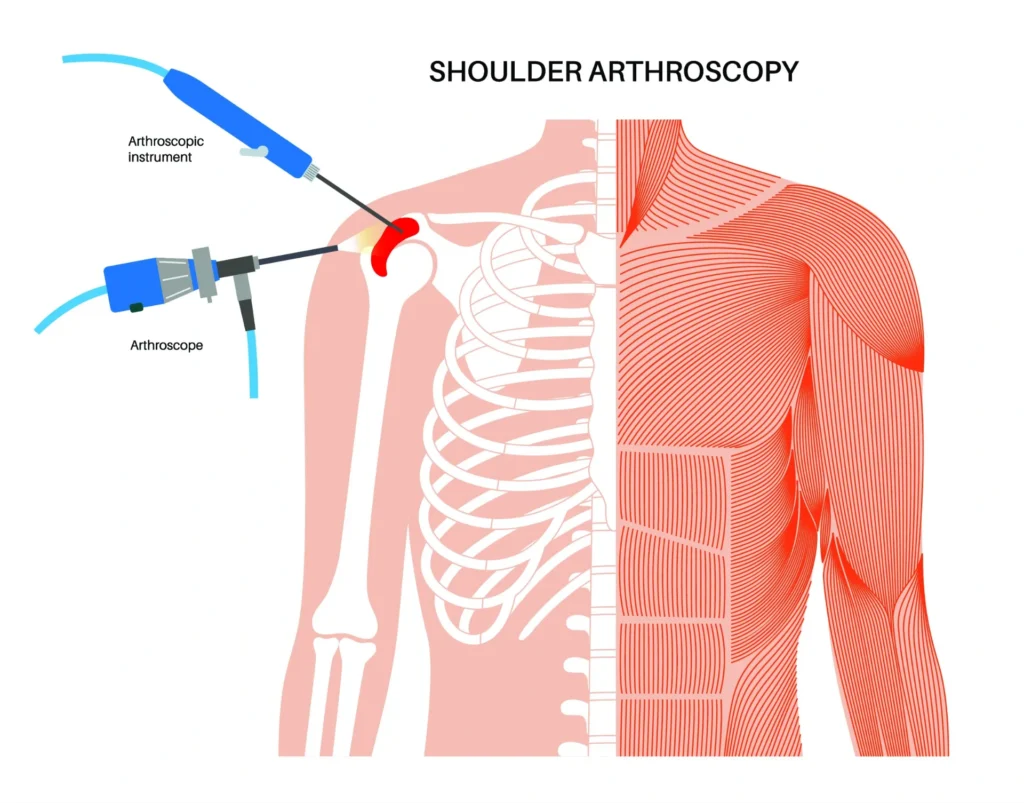
That’s the reason I protect repairs in a sling early on, limit active motion for several weeks, and introduce strengthening only after passive motion is well established. Each phase has a purpose. Every restriction has a reason.
What I See in My Patients
In my practice at the Detroit Orthopaedic Institute in Troy, the patients who come in needing rotator cuff repair usually have one thing in common: they waited. By the time we’re having a surgical conversation, most have already been through months of physical therapy, tried anti-inflammatory medications, and maybe received an injection or two that gave them temporary relief but didn’t solve the underlying problem.
A lot of my patients are active people who work with their hands or play recreational sports, and simply can’t keep up with their daily routine because of persistent shoulder weakness and pain. Many describe the same pattern: difficulty reaching overhead, pain that wakes them up at night when they roll onto the shoulder, and a gradual loss of strength that makes them feel like their arm just isn’t reliable anymore.
What I find on MRI tends to confirm what they’ve been experiencing. Most of the tears I repair are full-thickness, and many have some degree of muscle involvement that tells me the tear has been present for a while. That context matters, because larger or more chronic tears tend to require longer sling protection and longer rehab timelines.
Setting You Up Before the Surgery Date
One thing I’ve found makes a difference is what we do before the surgery. Many patients benefit from working with a physical therapist to optimize shoulder range of motion and strength in the weeks leading up to their procedure. We call this “prehab.”
I also spend time at the pre-op visit walking through the full recovery sequence so nothing catches patients off guard. This includes the sling duration, the early passive motion protocol, when they can expect to drive again, and more. The patients who understand the road ahead tend to navigate it better than those who are trying to figure it out in real time.
Rotator Cuff Surgery Recovery: Week by Week
Weeks 1–2: Protection and Pain Management
The first two weeks are about protection and managing discomfort. Your arm will be in a sling, and you’ll wear it most of the time, including while sleeping in many cases. This is not the time to test what you can or can’t do. The repair is at its most vulnerable, and protecting it takes priority.
Pain and swelling during this phase are normal and expected. We’ll have a pain management plan in place before you leave the hospital or surgery center. Ice, elevation, and prescribed medication tend to work well together during these early days. Most patients find the discomfort manageable once they have a routine.
Your physical therapist may introduce very gentle pendulum exercises during this phase. These are small, gravity-assisted arm swings that keep fluid moving in the joint and reduce stiffness without stressing the repair.
Weeks 3–6: Passive Range of Motion
This phase is about regaining motion without loading the repair. Your therapist will begin moving your arm through specific ranges (forward elevation, external rotation, maybe some gentle stretching), all done passively. Some aching after therapy sessions is expected and doesn’t mean anything is wrong. The sling is still your primary mode of protection at this stage.
What I don’t want patients doing during this phase: reaching for objects on high shelves, carrying anything with the repaired arm, or deciding the sling isn’t necessary because they’re feeling pretty good. Feeling good at week four does not mean the tendon is healed.
Weeks 6–12: Active Motion Begins
Around six weeks, and sometimes a little sooner or later depending on how things are progressing, you’ll get the green light to begin active motion. This is the point where you start using your own shoulder muscles to move the arm.
This phase tends to feel like real progress to patients, and it is. But it also brings new challenges. Muscles that have been protected and relatively quiet tend to feel weak and uncoordinated at first. Patients sometimes describe this as the arm feeling “foreign” or “disconnected.” That feeling tends to improve steadily over the following weeks as the neuromuscular patterns re-establish themselves.
You’ll also likely be cleared to drive around this time, which is a meaningful milestone for most people. Daily activities like reaching into cabinets and light personal care generally become more accessible during this window.
Weeks 12–20: Strengthening
This is the phase that separates the patients who do well from the ones who plateau. Twelve weeks and beyond is where dedicated, progressive strengthening work happens. Your therapist will guide you through targeted exercises for the rotator cuff muscles, the periscapular muscles, and the deltoid, building a foundation of stability and power that the repaired tendon can rely on.
This is also the phase where patients are sometimes tempted to do too much, too fast. A session that leaves the shoulder aching for three days is a session that was too aggressive. Progress should feel like a steady push, not a painful overcorrection.
Months 5–6 and Beyond: Return to Activity
By five to six months, most patients are experiencing meaningful improvements in strength, range of motion, and overall function. Many return to recreational activities during this window, including golf, cycling, and lighter gym work.
Return to overhead sports (tennis, swimming, baseball) typically takes longer and is guided by functional testing rather than time alone. I don’t use a calendar as my only guide here. I want to see that the strength and motion have genuinely been restored before I clear someone for high-demand activities.
Full recovery, including a return to physically demanding work or competitive sport, can take up to a year for larger repairs. That’s not a failure. That’s biology.
What Can Set Recovery Back
Rotator cuff surgery recovery tends to go off track for a few consistent reasons, and I think patients benefit from knowing them in advance.
Skipping physical therapy sessions is the most common reason that sets recovery back. I understand that life gets busy, especially for patients trying to manage work and family while recovering. But each missed session represents lost progress, and the cumulative effect of sporadic PT attendance tends to show up clearly in outcomes. This applies to home exercises as well.
Returning to weight bearing or overhead activity too early is the other major risk. A shoulder that feels fine at six weeks is not a shoulder that has finished healing. The tendon is still in the middle of its remodeling process. Overloading it during that window can lead to re-tear, which typically means starting the entire process over.
Smoking also impairs tendon healing, and I tell patients that directly. The research is clear on this. For patients in Southeast Michigan who are active smokers heading into surgery, I strongly encourage working to address this before the procedure.
Summary
Rotator cuff surgery recovery follows a predictable path, but it requires patience and consistency at every stage. Sling protection in the first four to six weeks, passive motion to start, active motion around week six, and progressive strengthening from twelve weeks onward. Most patients see significant functional improvement by six months, with full recovery extending to a year for larger repairs or more demanding goals.
If you’re somewhere in your recovery and something doesn’t feel right, such as unusual swelling, sudden loss of motion, or pain that seems to be getting worse instead of better, contact my office. These are worth a conversation.
If you’re still in the decision-making phase and want to understand whether surgery makes sense for your specific tear, I’d encourage you to explore the shoulder disorders page on my site and then schedule a consultation. The right answer for you depends on the condition, your activity goals, and what you’ve already tried, and I’d rather make that determination together than have you figure it out alone.
Frequently Asked Questions
How long will I be in a sling after rotator cuff surgery?
Sling duration varies depending on the size and complexity of the repair. Most patients wear a sling for four to six weeks. Larger or more complex repairs may require longer protection. Your surgeon will give you specific guidance based on what was done during your procedure.
Is it normal to still have pain at three months post-op?
Some residual aching and stiffness at three months is not unusual, especially during or after physical therapy sessions. Full pain resolution can take longer than most patients expect. A sudden increase in pain, new swelling, or a significant loss of motion that was previously gained should prompt a call to your surgical team.
Can I do anything to speed up rotator cuff surgery recovery?
Consistent physical therapy, good nutrition, adequate sleep, and avoiding the temptation to do too much too soon are the best tools available. Some patients ask about regenerative medicine options to support healing. This is something worth discussing with your surgeon before or during recovery, as regenerative approaches may be appropriate in select cases.