


Medically reviewed by Shariff K. Bishai, DO, MS
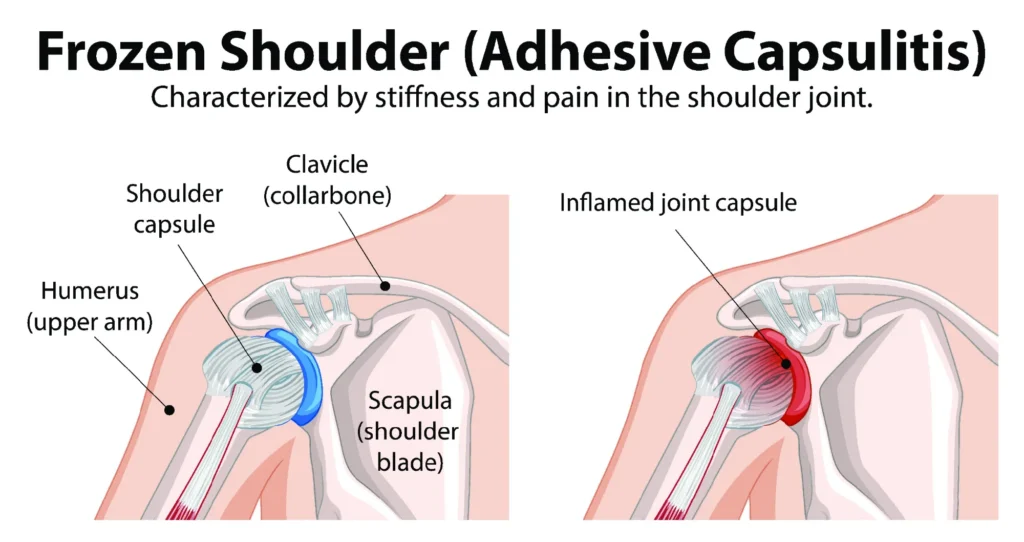
Patients often come into my Troy office describing the same frustrating experience: their shoulder feels stuck, painful, and almost impossible to move. They may have already been told they have a “frozen shoulder,” while their chart calls it adhesive capsulitis. Those terms refer to the same condition, but there is an important distinction between a shoulder that simply feels stiff and one that is truly affected by adhesive capsulitis. With adhesive capsulitis, the capsule surrounding the shoulder joint becomes inflamed, thickened, and progressively tighter, restricting motion in a characteristic way. Recognizing that difference is important because not every stiff or painful shoulder needs the same treatment.
Key Takeaways
- Adhesive capsulitis and frozen shoulder are the same diagnosis. The clinical name points at the joint capsule, which thickens and forms adhesions that limit motion.
- Primary adhesive capsulitis develops without a clear trigger. Secondary adhesive capsulitis follows an injury, a surgery, or a stretch of time in a sling.
- The defining finding is loss of passive motion. When someone else cannot move your arm through its range either, the restriction is usually coming from the capsule rather than a weak or torn tendon.
- Several other shoulder problems imitate it closely. A stiff, painful shoulder is not automatically a frozen one.
Why the Clinical Name Describes the Problem Better
Take the term “adhesive capsulitis” apart and it stops sounding intimidating. Capsulitis means inflammation of the joint capsule. Adhesive refers to the adhesions, the bands of scar-like tissue that form inside that capsule and tether surfaces together that are supposed to glide.
The shoulder capsule is a sleeve of connective tissue that surrounds the ball-and-socket joint. In a healthy shoulder it is loose and forgiving, which is part of why the shoulder moves through more range than any other joint in the body. When the capsule inflames, it thickens and contracts. The space inside the joint shrinks. The arm runs into a hard wall of tissue long before it should.
I find that patients engage with treatment differently once they can picture a sleeve tightening around the joint instead of a vague freeze. Stretching a tight sleeve is a slow, repetitive job, and knowing that up front makes the timeline easier to accept.
Primary and Secondary Adhesive Capsulitis
Primary adhesive capsulitis shows up without an obvious cause. Nothing tore. Nobody fell. The shoulder simply started hurting at night and then stopped moving. It most often appears between the ages of 40 and 60, and it occurs more frequently in women. Diabetes is the strongest single risk factor we know of. Thyroid disorders, Parkinson’s disease, and cardiovascular disease also show up more frequently than chance would predict.
Secondary adhesive capsulitis follows something, like a fracture that required a sling or weeks of guarding a sore shoulder because moving it hurt. The capsule tightens in the setting of immobility, and the original problem sometimes finishes healing while the stiffness keeps going.
That distinction changes how aggressively I move early. A secondary case caught in the first several weeks, while the tissue is still pliable, tends to respond faster than a primary case that has already settled into a deep freeze.
The Exam Finding That Usually Settles It
The most useful part of a frozen shoulder evaluation costs nothing and takes about a minute. I ask the patient to raise the arm themselves, then I relax the arm and move it for them. Those two things have names. Active motion is what you can produce with your own muscles. Passive motion is what the joint allows when someone else does the work.
In a shoulder with true adhesive capsulitis, both are restricted, and they are restricted to a similar degree. External rotation with the elbow tucked at the side is typically the first motion to go and the most stubbornly limited. A rotator cuff problem behaves differently. Weakness or a tear tends to limit what the patient can lift, while the arm often still moves reasonably well when I move it.
What Gets Mistaken for Adhesive Capsulitis
Glenohumeral arthritis is the imitation I see most often. Worn cartilage restricts passive motion too, and an arthritic shoulder can look almost identical across the room. An X-ray usually separates them quickly.
Calcific tendinitis is another, and it can produce pain severe enough that patients stop moving the arm entirely, which then produces real stiffness on top of the original problem.
A shoulder that has quietly stiffened sometimes gets labeled as shoulder impingement syndrome and sent to therapy for strengthening, which is not what a contracted capsule needs.
Rotator cuff pathology belongs on the list as well. A large tear can limit what someone lifts so severely that the shoulder looks frozen from a distance. The passive motion check usually sorts that out.
What I See in My Patients
Metro Detroit gives me a particular version of this condition. Diabetes is common across the communities I serve, and a meaningful share of the frozen shoulders I evaluate in Troy come attached to a diabetes diagnosis, sometimes one the patient has been managing for years and sometimes one that turns up because we went looking.
Winter brings me the other version. Someone slips on an icy driveway in January, bruises the shoulder, wears a sling for two weeks because it hurts, and arrives in March unable to reach the seatbelt. The bruise healed. The capsule tightened.
I also see a pattern I would call the wait-it-out group. People are told frozen shoulder resolves on its own, so they give it a year before calling anyone. Some of them do fine. Others arrive with motion so limited that they cannot fasten a bra, reach a back pocket, or work overhead, and by then we are climbing out of a deeper hole than we needed to. Waiting is a legitimate choice, but waiting without a diagnosis is more of a gamble.
How I Approach an Adhesive Capsulitis Diagnosis
My first job is confirming the diagnosis, and my second is figuring out which phase the shoulder is in, because the phase drives everything else. A shoulder in the painful, inflammatory stage needs the inflammation addressed before anyone stretches it hard. A shoulder that has quieted down but stayed stiff needs consistent, patient stretching more than it needs another injection. The full staging and treatment ladder is laid out in more detail in my post on frozen shoulder causes, stages, and treatment options.
Conservative care handles the large majority of these shoulders. That generally means a therapy program built around low-load, longer-duration stretching rather than aggressive forcing, anti-inflammatory medication where appropriate, and a corticosteroid injection when pain is the thing blocking progress.
When a patient has put in months of honest effort and the motion has genuinely stalled, manipulation under anesthesia or an arthroscopic capsular release becomes a reasonable conversation. Those procedures work best when the patient is ready to attack therapy immediately afterward. Surgery may buy back range of motion. Keeping it is the patient’s half of the deal.
Patients with diabetes get one extra piece of the conversation. Blood sugar control and shoulder recovery appear to be connected. Managing it is a key part of the story.
Summary
Adhesive capsulitis is the clinical name for frozen shoulder, and the name earns its keep by pointing at the tissue that is actually the problem. The capsule thickens, adhesions form, and the joint loses room to move. Loss of passive motion is the finding that separates it from a rotator cuff problem, and primary cases behave differently from the secondary ones that follow an injury or a sling.
If your shoulder has been stiffening for more than a few weeks and someone else cannot move it any further than you can, get it examined rather than waiting for the calendar to fix it. You can request an appointment with my office in Troy.
Frequently Asked Questions
Is adhesive capsulitis the same thing as frozen shoulder?
Yes. They are two names for one condition. Frozen shoulder is the term patients use, and adhesive capsulitis is the term that appears in medical records and referrals. Nothing about the diagnosis, the prognosis, or the treatment changes based on which name gets written down.
How long does adhesive capsulitis usually last?
It tends to move through phases, and the whole arc often runs somewhere between one and three years. The painful freezing phase commonly lasts several months, the stiff frozen phase can run longer, and the thawing phase is the slowest and least predictable of the three. Treatment does not typically eliminate the phases, though it often shortens them and makes the painful stretch considerably more tolerable.
Will adhesive capsulitis resolve on its own?
Many cases do improve substantially over time without surgery. That is a real phenomenon, and it is why I take a conservative approach in most patients. It is not a reason to skip the evaluation. Some shoulders do not fully recover their range, some are not adhesive capsulitis at all, and a stiff shoulder that turns out to be arthritis is not going to thaw the way a frozen shoulder does.
Should I rest my shoulder or keep using it?
Generally, you can keep using it within the range that does not provoke sharp pain. Prolonged rest tends to make a stiffening shoulder worse, since immobility is part of what drives the capsule to contract in the first place. Gentle, frequent motion beats occasional forceful stretching. If a movement causes pain that lingers for hours afterward, you have pushed past the useful range.