

Medically reviewed by Shariff K. Bishai, DO, MS | Reviewed June 2026
Frozen shoulder is one of those conditions that tends to sneak up on people. One day you notice a little stiffness when reaching overhead. A few weeks later, you can’t lift your arm past your waist without pain. By the time many of my patients make it into my office at Detroit Orthopaedic Institute in Troy, they’ve been dealing with this for months, sometimes wondering if something more serious is going on. In this post, I’ll walk you through what frozen shoulder actually is, why it happens, the stages it tends to follow, and what options I typically discuss with patients here in the Detroit area.
Key Takeaways
- Frozen shoulder (adhesive capsulitis) occurs when the joint capsule thickens and tightens, leading to progressive stiffness and pain that can last months to years.
- The condition tends to move through three stages (freezing, frozen, and thawing), and most patients recover, though the timeline varies considerably.
- Treatment options range from physical therapy and medications to manipulation under anesthesia or arthroscopic release for cases that don’t respond to conservative care.
What Is Frozen Shoulder?
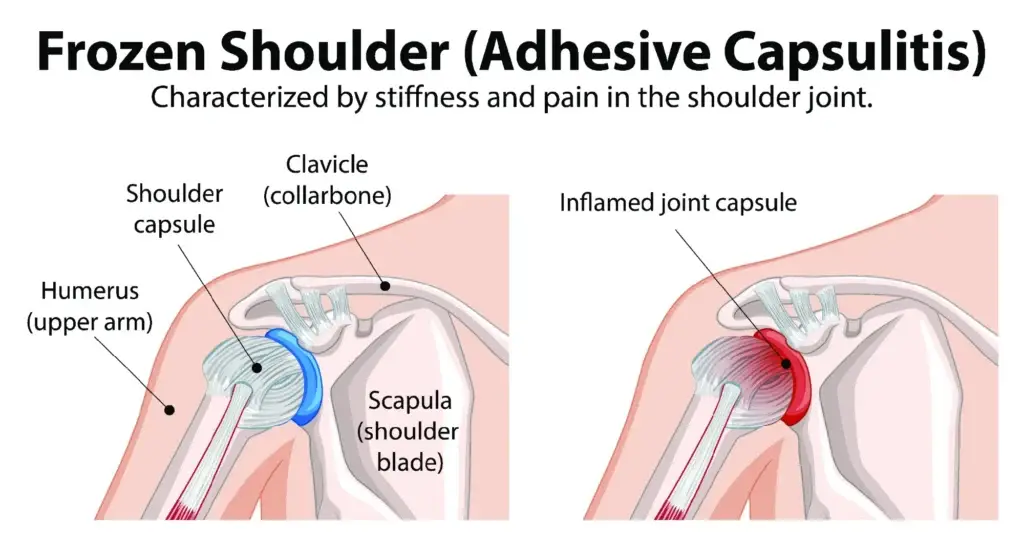
Frozen shoulder, also called adhesive capsulitis, is a condition in which the capsule surrounding the shoulder joint thickens, contracts, and becomes inflamed. The capsule is a layer of connective tissue that normally has some give to it, allowing the arm to move freely in multiple directions. When that capsule tightens, movement becomes painful and increasingly restricted.
The shoulder is the most mobile joint in the body. That mobility depends on the capsule having the right amount of flexibility. With frozen shoulder, small adhesions (bands of scar-like tissue) can develop within the capsule, further limiting motion. Over time, patients may lose the ability to raise their arm, reach behind their back, or do something as simple as fasten a seatbelt without pain.
Causes and Risk Factors
Frozen shoulder can develop after an injury, a surgical procedure, or even just a period where the shoulder wasn’t being used much. When the arm stays still for an extended time, whether from a fracture, a rotator cuff repair, or another condition, the capsule may begin to contract. This is why many orthopedic surgeons, myself included, emphasize early motion after shoulder procedures.
It’s not always fully understood why the capsule begins this process in some people and not others. What we do know is that frozen shoulder tends to affect people between the ages of 40 and 60, affects women somewhat more often than men, and often develops following a period of immobility or in association with certain medical conditions.
Diabetes is the most well-established risk factor. People with diabetes develop frozen shoulder at notably higher rates, and their recovery tends to take longer and be more challenging. The exact mechanism isn’t entirely clear, but changes in connective tissue metabolism and inflammatory pathways may play a role. Thyroid disorders, Parkinson’s disease, and cardiovascular disease have also been associated with increased risk.
Some cases appear to develop without any obvious trigger at all. A patient wakes up one morning with a stiff shoulder and no prior injury.
The Three Stages of Frozen Shoulder
Frozen shoulder generally moves through three overlapping phases.
Stage 1: Freezing
This is the painful phase. The shoulder starts to ache, usually more at night, and motion begins to feel limited. Reaching overhead, rotating the arm outward, or tucking the hand behind the back may become noticeably uncomfortable. The capsule is actively inflaming and contracting during this stage. Pain tends to be the dominant complaint, and it can be quite disruptive to sleep and daily activity.
This stage may last roughly two to nine months, though the range varies. Patients often describe it as the hardest part because the pain can be constant and doesn’t seem to follow any logic; it may flare without provocation.
Stage 2: Frozen
In the frozen stage, the acute pain may begin to ease, but stiffness reaches its peak. Motion loss can be severe. Some patients can barely lift their arm to shoulder height. The shoulder feels locked.
This stage typically lasts four to twelve months. Day-to-day tasks like dressing, reaching into a cabinet, and driving can be challenging. Patients often shift their body rather than their arm to accomplish basic movements, and the surrounding muscles can start to feel the strain from that.
Stage 3: Thawing
The thawing stage is when motion gradually begins to return. This can be slow, and the improvement isn’t always linear. Some weeks feel like progress, others don’t. But over time, the capsule relaxes, adhesions soften, and range of motion improves. For many patients, this stage lasts five months to two years.
Most people do recover meaningful motion, though not everyone returns to exactly where they were before.
What I See in My Patients
At my practice here in Troy, I see a fair amount of frozen shoulder. What strikes me is how often patients have been sitting with it for six months or more before coming in. They’ve tried heat, stretching, and waiting. A few have tried ignoring it entirely. By the time I see them, they’re frustrated, sleep-deprived, and sometimes convinced something much worse is happening.
One of the first things I look for in the exam room is whether the loss of motion is “passive,” meaning it’s limited even when I’m moving the arm, not just when the patient tries to move it themselves. With frozen shoulder, that passive restriction is a hallmark. With other shoulder problems, like a rotator cuff tear, the patient often has weakness but I can still move the arm through a fuller arc.
I find that the patients who do best are the ones who stay engaged: those who keep up with their home stretching, who communicate when something isn’t working, and who don’t give up when progress feels slow. Frozen shoulder is a condition that rewards consistency.
My Approach to Treatment
My starting point with most frozen shoulder patients is always conservative care. The capsule responds over time, and for many people, a structured non-surgical approach is enough to get there.
Physical Therapy and Stretching
The goal of physical therapy isn’t to push through pain aggressively (that can sometimes make inflammation worse) but to maintain what motion remains and gradually improve it. I typically recommend consistent, low-load stretching over time rather than forced manipulation at home. Pendulum exercises, cross-body reaches, and gentle external rotation stretches tend to be the building blocks.
Medications and Injections
Anti-inflammatory medications can help take the edge off pain, particularly during the freezing stage when inflammation is most active. For patients with significant pain, a corticosteroid injection directly into the joint may offer meaningful relief and make it easier to participate in therapy. The timing matters, as injections tend to be more effective earlier in the process, when inflammation is driving symptoms. I don’t rely on injections indefinitely, but as part of a broader plan, they may help bridge patients through a difficult stretch.
Manipulation Under Anesthesia
For patients who have not improved adequately with conservative treatment, manipulation under anesthesia may be an option. With the patient asleep, I carefully and methodically move the arm through its range of motion to break up the adhesions that have formed within the capsule. The procedure is relatively brief, but what happens afterward matters just as much. Patients need to commit to immediate and consistent therapy to maintain the motion that was gained.
Arthroscopic Capsular Release
When other approaches haven’t delivered adequate results, arthroscopic release is the next step I consider. Using small incisions and a camera, I can directly visualize the capsule and release the tightened tissue in a controlled way.
The right treatment path depends on where a patient is in the course of their condition, how much it’s affecting their life, and what their goals are. I don’t believe in a one-size-fits-all approach here. Those conversations are worth having carefully. If you’re dealing with something that sounds like this, I’d encourage you to schedule a consultation to get a clear picture of where you are and what makes sense for you.
Summary
Frozen shoulder can be an uncomfortable condition, but it’s also one that responds well to treatment when caught and managed appropriately. The three stages (freezing, frozen, and thawing) can span one to three years in some patients, but most people do recover meaningful motion with the right care. Conservative treatment works for many. For those who need more, procedures like manipulation under anesthesia or arthroscopic capsular release can provide the kind of relief that lets people sleep again, move again, and get back to living.
Frequently Asked Questions
Can frozen shoulder go away on its own?
Many cases do improve over time even without aggressive intervention. However, that process can take one to three years, and waiting without any treatment tends to prolong the frozen and thawing stages. Most patients do better with some form of guided care, whether that’s therapy, injections, or a combination, than with a purely watchful approach.
Does frozen shoulder come back after it resolves?
Recurrence in the same shoulder is uncommon, but possible. Some patients do develop frozen shoulder in the opposite shoulder at some point. If you have known risk factors like diabetes, staying aware of any early stiffness in the other shoulder may help you get ahead of it sooner.
Is surgery always necessary for frozen shoulder?
No. The majority of patients with frozen shoulder improve with non-surgical treatment. Procedures like manipulation under anesthesia or arthroscopic capsular release are reserved for cases that haven’t responded adequately to conservative care over a reasonable period of time. Surgery is a tool for the right situation, not the first line for every patient.
How long does recovery take after arthroscopic capsular release?
Recovery varies, but most patients begin therapy quickly after surgery to maintain the motion gained. Meaningful improvement in motion tends to be evident within the first several weeks, with continued progress over three to six months. Commitment to post-operative therapy is essential. The procedure creates the opportunity, but therapy is what makes the improvement stick.