

Medically reviewed by Shariff K. Bishai, DO, MS | Reviewed June 2026
Wondering how long shoulder replacement recovery takes? It’s one of the most common questions I hear from patients who come to see me at Detroit Orthopaedic Institute. It makes sense, since you want to know what you’re signing up for before you commit to surgery. The more you understand about the recovery process, the better you can prepare for it, and preparation is one of the biggest factors in how well things go.
So let me walk you through what shoulder replacement recovery actually looks like, based on a realistic picture grounded in what I see in my practice here in the Metro Detroit area.
Key Takeaways
- Most patients wear a sling for the first four to six weeks after shoulder replacement, depending on the type of procedure and individual factors.
- Physical therapy begins soon after surgery and plays a central role in restoring strength and range of motion throughout the recovery period.
- Full recovery from shoulder replacement tends to take six months to a year or longer, though many patients notice meaningful progress much earlier.
What Shoulder Replacement Surgery Actually Involves
Shoulder replacement surgery (also called shoulder arthroplasty) involves replacing the damaged surfaces of the shoulder joint with implants designed to restore smooth, more comfortable movement. When the cartilage that cushions the joint wears down significantly from arthritis, injury, or rotator cuff damage, the shoulder loses its ability to move without pain. That’s typically the point where surgery becomes a reasonable conversation to have.
There are two primary types of shoulder replacement I perform: total (anatomic) shoulder replacement and reverse shoulder replacement. They’re not interchangeable, and the distinction matters for recovery.
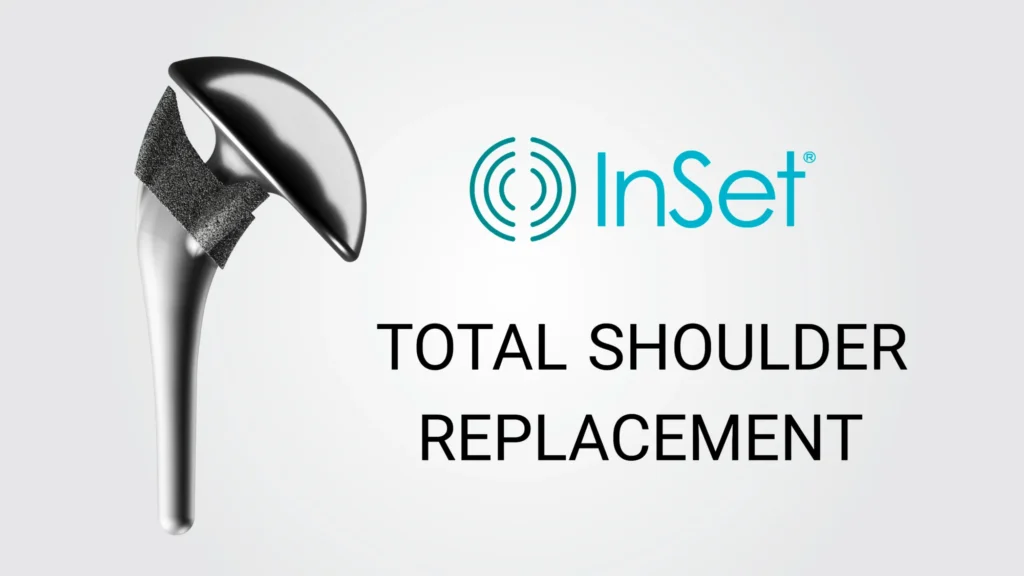
In a total shoulder replacement, I replace both the humeral head (the ball of the upper arm bone) and the glenoid socket (the shallow dish on the shoulder blade) with implants that replicate the shoulder’s natural anatomy. This procedure tends to work best when a patient’s rotator cuff is still intact and functional. Think of it as restoring the shoulder based on its natural anatomy.
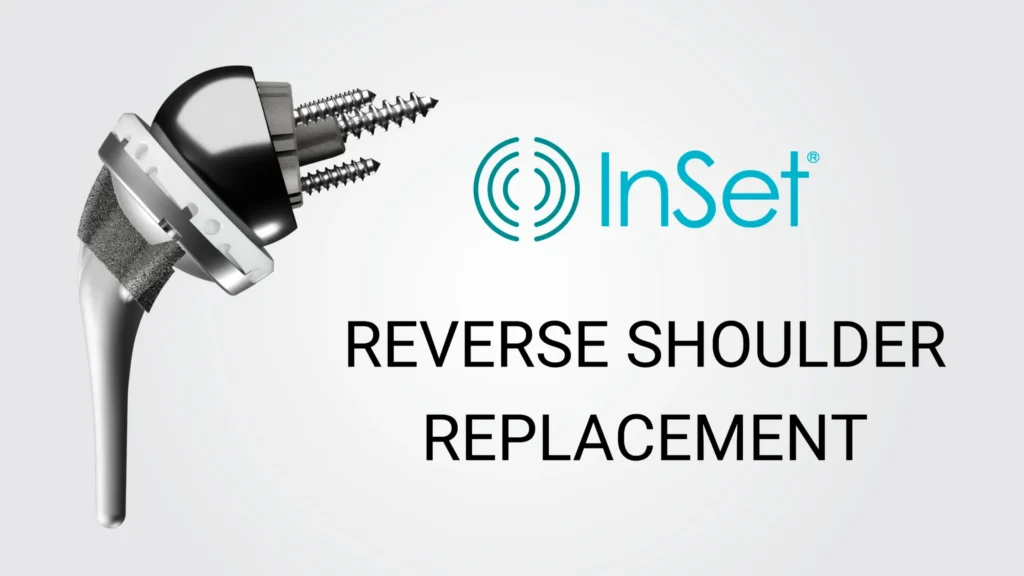
A reverse shoulder replacement, by contrast, flips the ball-and-socket configuration. The metal ball goes on the glenoid side, and the socket component sits on the humerus. This design allows the deltoid muscle to take over much of the work that a damaged or irreparable rotator cuff can no longer perform. I typically recommend this approach for patients who have both arthritis and a rotator cuff that’s too far gone to support an anatomic replacement.
For total shoulder replacements, I use the InSet® Total Shoulder System by Shoulder Innovations. The glenoid implant is positioned within the strongest supporting bone rather than sitting on top of it, designed to help reduce the loosening that’s historically been a leading cause of failure in total shoulder replacement. It’s also bone-preserving, which matters if a revision is ever needed later.
For reverse cases, I use the InSet® Reverse System. Its lateralized-lateralized design helps the shoulder behave more like a natural joint post-operatively, which translates to better rotational capacity and, ideally, more functional motion for the patient. I also use ProVoyance®, a 3D planning software that lets me virtually map each patient’s anatomy before surgery, improving precision in implant sizing and positioning for the day of the procedure.
What to Expect Immediately After Surgery
Most shoulder replacement surgeries I perform are done on an outpatient basis or with a short hospital stay. Patients go home the same day or the next day. They leave with a sling, a pain management plan, and specific instructions from my team about what to do and what to avoid.
Pain in the first week or two tends to be manageable for most patients, particularly with the medication plan we set up ahead of time. Some patients also receive a nerve block as part of their anesthesia, which can reduce early post-operative pain significantly. The nerve block typically wears off within twelve to twenty-four hours, and that transition can be uncomfortable. I prepare patients for it so it doesn’t catch them off guard.
Swelling and some bruising around the shoulder are common. Ice application during the first several days helps. Driving is off the table until the sling comes off and clearance is given.
What I See in My Patients: The Reality of Recovery
I want to be straightforward with you about something: shoulder replacement recovery is a longer process than most people expect going in. I tell patients in my office to plan for a six- to twelve-month recovery. The patients who come to terms with the timeline early are also the ones who tend to approach rehab the right way. Those who think they’ll feel “back to normal” in a few weeks are often the same ones who call in frustrated at month four because they’re still stiff.
Here’s what I see most commonly in my patients:
In the first two weeks, most people are managing pain and getting used to wearing a sling. They can handle light activities (short walks, basic self-care with the other arm) but the surgical arm stays protected. Physical therapy starts early on with passive range-of-motion exercises, where the therapist or a pulley system does the moving rather than your shoulder muscles. Active motion, where your muscles do the work, starts later in the process.
During weeks four through six, most of my patients come out of the sling, though this can vary depending on individual healing factors. This is something I discuss specifically with each patient at their follow-up visits.
Shoulder replacement patients almost always go through a period where things feel worse before they feel better. The three-to-six-month range is where patients typically make the most noticeable gains. They may sleep better and be able to reach for things without wincing.
By six months to a year, many patients are close to their functional plateau. They may still be improving at twelve months, particularly with strength and endurance. Some patients, especially those who had significant pre-operative stiffness or deconditioning, may continue to see gradual improvement even beyond the one-year mark.
How the Type of Replacement Affects Recovery
The recovery experience for total shoulder replacement and reverse shoulder replacement differs in some meaningful ways, and I think it’s worth being specific about that.
After a total shoulder replacement, rehabilitation tends to focus on protecting the new joint while restoring natural movement patterns. Because the rotator cuff is functional, rehab can build on it.
Reverse shoulder replacement recovery places a heavier emphasis on the deltoid muscle. Since the deltoid becomes the primary mover after this procedure, strengthening it is central to rehab. Early on, the goal is arm elevation, including regaining the ability to lift the arm forward and to the side. That recovery from functional deficit is one of the most rewarding things I see in my practice. Picture a patient who walks in unable to raise their arm past waist height and walks out six months later reaching into an overhead cabinet. That kind of change in someone’s daily life is exactly why I do this work.
Recovery timelines for both procedures generally run on a similar calendar. The difference is more about what the rehab focuses on than how long it takes.
My Approach to Recovery
I tell every shoulder replacement patient the same thing before they leave: your job just started. Surgery gets the shoulder to a place where recovery is possible. Rehabilitation is what makes the recovery actually happen. No amount of good surgical technique compensates for a patient who skips PT or rushes back to activities too soon. I’ve seen the difference it makes.
Factors That Influence How Long Recovery Takes
Not everyone recovers on the same schedule, and that’s not a flaw in the system; it’s just the reality of biology and circumstance. Several factors may influence how quickly a patient progresses:
Overall health and conditioning going into surgery. Patients who come in with better baseline strength and cardiovascular health often recover more efficiently. I encourage patients to do whatever gentle conditioning they can manage before surgery, even if their shoulder limits what that looks like.
The extent of pre-surgical degeneration. A shoulder that has been severely arthritic for years, with muscle atrophy and loss of motion, may take longer to rehabilitate than a shoulder where surgery is done earlier in the disease process.
Adherence to physical therapy. The difference between a patient who commits fully to their PT program and one who attends sporadically is often visible at the six-month mark.
Age and healing biology. Older patients may heal more slowly, which is expected and not a barrier to good outcomes. It just means the timeline may extend toward the longer end of the range.
Summary
Shoulder replacement recovery is a meaningful commitment, and I don’t think patients are served well by minimizing that. The patients I see who achieve their best outcomes are the ones who trust the timeline, take physical therapy seriously, and come back to my office when something doesn’t feel right.
If you’re in the Detroit area and considering shoulder replacement, or if you’ve been told by another provider that surgery may be the right next step, I’d encourage you to schedule a consultation. Understanding what your specific shoulder needs, and building a recovery plan around your goals, your anatomy, and your life, is exactly the kind of conversation I value having with patients before they make any decisions.
Frequently Asked Questions
Is physical therapy really necessary, or can I do exercises on my own at home?
Physical therapy is an important part of shoulder replacement recovery, not an optional add-on. Therapists guide the progression of exercises in a way that protects healing tissue while steadily building motion and strength.
What activities can I return to after shoulder replacement?
Many patients return to everyday activities like reaching, cooking, light yard work, and low-impact sports such as golf or swimming over the course of recovery. Certain activities involving heavy lifting, contact sports, or repetitive overhead loading may need to be permanently modified to protect the implant. I discuss long-term activity expectations with each patient based on the type of replacement and their individual goals.
How do I know if something is wrong during recovery?
Signs that warrant a call to my office include pain that suddenly worsens after a period of improvement, significant swelling, redness or warmth around the incision, new numbness or tingling in the arm or hand, or any sensation of the shoulder shifting or giving way. These don’t always indicate a serious problem, but they should be evaluated rather than managed at home. When in doubt, reach out.