


Shoulder stiffness is one of the most common complaints that brings patients to an orthopedic surgeon’s office. It can range from mild tightness after a night’s sleep to a loss of motion that makes simple daily tasks, like reaching overhead, fastening a seatbelt, or brushing your hair, feel nearly impossible. Whether it develops gradually over time or follows an injury or medical procedure, shoulder stiffness deserves attention. In this post, we’ll cover what shoulder stiffness is, what commonly causes it, how it is diagnosed, and what your treatment options may look like.
Key Takeaways
- Shoulder stiffness can result from several conditions, including frozen shoulder, arthritis, rotator cuff injuries, and post-surgical changes.
- Many cases of shoulder stiffness respond well to conservative treatments such as physical therapy, stretching, and anti-inflammatory medications, depending on the underlying cause.
- Surgical options may be available for patients who do not improve with non-operative care.
What Is Shoulder Stiffness?
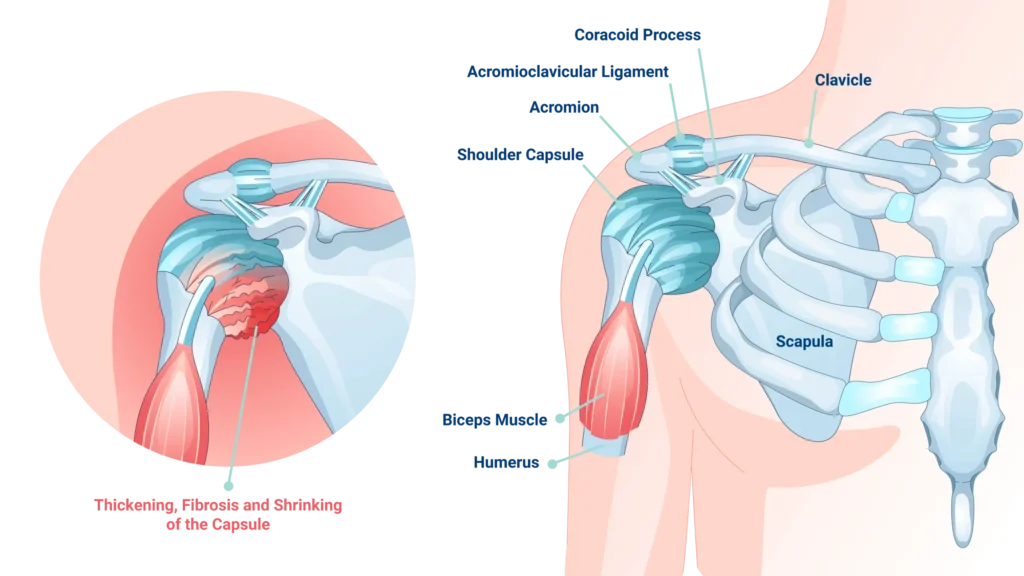
The shoulder relies on a complex interaction of bones, tendons, muscles, and a soft tissue envelope called the joint capsule to achieve its range of motion. When any part of that system becomes inflamed, thickened, or damaged, movement can become restricted and painful.
Shoulder stiffness refers to a reduction in normal joint motion, often accompanied by pain, tightness, or a sense of resistance when moving the arm. It may affect your ability to raise your arm overhead, rotate it behind your back, or reach across your body. Some people notice stiffness only in certain directions. Others experience a more global loss of motion across multiple planes of movement, making it difficult to perform even routine activities.
The condition may develop slowly over several months or appear more suddenly following an injury or procedure. Regardless of how it starts, shoulder stiffness is a signal worth listening to. The joint is designed to move through a large arc freely and without pain. When that capacity diminishes, it may reflect an underlying problem.
Common Causes of Shoulder Stiffness
Shoulder stiffness rarely develops without reason. In most cases, an underlying condition or event sets the process in motion. Understanding the possible causes can help patients have more informed conversations with their care team.
Frozen Shoulder (Adhesive Capsulitis)
Frozen shoulder is perhaps the most well-known cause of shoulder stiffness. It occurs when the tissue surrounding the shoulder joint, known as the joint capsule, becomes inflamed and tightens, significantly restricting movement. The condition tends to progress through three recognizable phases: a freezing phase marked by increasing pain and stiffness, a frozen phase where motion remains severely limited, and a thawing phase during which motion gradually returns. This process may unfold over several years in some patients.
Women, people between the ages of 40 and 60, and individuals with conditions such as diabetes or thyroid disease may be at somewhat higher risk, though frozen shoulder can occur in anyone.
Rotator Cuff Injuries and Tendinopathy
The rotator cuff is a group of four muscles and their tendons that stabilize and move the shoulder. When one or more of these tendons becomes inflamed, torn, or degenerated, it can contribute to shoulder stiffness. Rotator cuff tears, in particular, may lead to altered movement patterns that place additional strain on the joint capsule over time, sometimes creating a secondary stiffness even when the tear itself is the primary problem.
Osteoarthritis
Like other joints in the body, the shoulder can be affected by osteoarthritis, the gradual breakdown of protective cartilage. As cartilage gradually wears away, the joint may become inflamed and less smooth, leading to pain, swelling, and progressive stiffness. Arthritis in the glenohumeral joint (the ball-and-socket) or the acromioclavicular (AC) joint can both contribute to restricted motion and discomfort with activity.
Post-Surgical or Post-Injury Stiffness
Shoulder stiffness sometimes develops as a complication following surgery or after an injury such as a fracture or dislocation. Scar tissue may form during the healing process, potentially limiting the joint’s ability to move freely. This is one reason early, guided rehabilitation after shoulder surgery tends to be so important.
Calcific Tendinitis
Calcium deposits that form within the tendons of the rotator cuff can cause intense pain and may also restrict motion. While calcific tendinitis frequently presents with acute, severe pain, it may also lead to temporary stiffness or reduced motion as patients limit movement due to discomfort.
How Is Shoulder Stiffness Diagnosed?
A thorough evaluation by an orthopedic specialist forms the foundation of an accurate diagnosis. During your visit, your doctor will review your medical history and discuss when symptoms began, how they have progressed, and what activities make them better or worse.
The physical exam typically includes a careful assessment of how far the shoulder can move, both actively (with your own muscle effort) and passively (with gentle assistance). Comparing motion between both shoulders can reveal meaningful differences. Strength testing and palpation of specific structures around the shoulder may also help identify the underlying cause.
Imaging studies often play an important role as well. X-rays can identify bone changes, arthritis, calcium deposits, and fractures. An MRI may provide more detailed information about soft tissues, including the rotator cuff, labrum, and joint capsule. In some situations, a CT scan or diagnostic ultrasound may also be recommended.
The goal of the diagnostic process is not simply to confirm that stiffness. The goal is to understand why it developed so that treatment can be properly targeted and effective. Getting that clarity can make a meaningful difference in both the speed and quality of your recovery.
Treatment Options for Shoulder Stiffness
Treatment depends on the cause and severity of the stiffness, as well as the patient’s overall health, activity level, and personal goals. In many cases, non-operative approaches are tried first and may produce meaningful improvement over time. An experienced orthopedic specialist can evaluate your shoulder and help guide the most appropriate treatment response.
Physical Therapy and Stretching
Physical therapy is often a component of treatment for shoulder stiffness. A skilled therapist can guide patients through targeted stretching and strengthening exercises designed to gradually restore range of motion while minimizing pain. It is important to be consistent and follow your program closely.
Medications
Anti-inflammatory medications, such as nonsteroidal anti-inflammatory drugs (NSAIDs), may help reduce pain and swelling enough to allow more effective participation in physical therapy.
Corticosteroid Injections
For patients with significant pain and inflammation, a corticosteroid injection into the shoulder joint or surrounding bursa may be used to provide temporary relief. Injections may make it considerably easier to engage with physical therapy by reducing the pain that otherwise limits participation and progress.
Platelet-Rich Plasma Therapy
For certain conditions, a PRP injection may be considered. This treatment uses components of the patient’s own blood that are concentrated and injected into the affected area with the goal of supporting tissue healing.
Hydrodilatation
Hydrodilatation involves injecting a mixture of saline, corticosteroid, and local anesthetic into the joint capsule under imaging guidance. The goal is to stretch the capsule and disrupt adhesions that are restricting motion. This procedure may be a reasonable option for certain patients with frozen shoulder who have not responded adequately to other conservative measures.
Surgical Options
When conservative treatment fails to restore adequate motion and a patient’s quality of life remains significantly affected, surgery may be considered. Options that may be discussed include:
- Manipulation under anesthesia (MUA): The surgeon gently moves the shoulder through its range of motion while the patient is under anesthesia, with the goal of restoring mobility.
- Arthroscopic capsular release: Using small instruments inserted through tiny incisions, the surgeon releases the tightened joint capsule to allow the shoulder to move more freely.
- Shoulder replacement surgery: For patients whose stiffness is primarily driven by advanced arthritis or significant structural damage, joint replacement may offer the best long-term relief.
The most appropriate surgical option depends entirely on the individual patient. Your doctor should discuss the risks, benefits, and expected outcomes thoroughly before recommending any procedure.
Staying Proactive About Shoulder Health
While not all causes of shoulder stiffness are preventable, maintaining shoulder health through regular movement and activity can be beneficial for many people. Avoiding prolonged periods of inactivity, staying engaged in light stretching if you have a sedentary job, and addressing shoulder pain early rather than waiting for it to worsen are all reasonable strategies. If you have recently undergone shoulder surgery or experienced an injury, following your rehabilitation plan closely may help reduce the likelihood of developing significant stiffness during the healing process.
Summary
Shoulder stiffness can significantly impact daily life, but many patients experience meaningful improvement with proper evaluation and targeted treatment tailored to the underlying cause. Whether the cause is frozen shoulder, rotator cuff disease, arthritis, or post-surgical scarring, a range of effective options exists, from physical therapy and injections to minimally invasive surgical procedures. If you have been experiencing limited shoulder motion or persistent pain, reaching out to an orthopedic specialist is a reasonable next step.
Frequently Asked Questions About Shoulder Stiffness
How long does shoulder stiffness typically last?
The duration depends largely on the underlying cause. Frozen shoulder often progresses over one to three years, though treatment may help improve symptoms and restore motion sooner for many patients. Stiffness related to a minor injury or brief immobilization may improve within weeks with appropriate stretching and activity modification. An evaluation by an orthopedic specialist can help you better understand what to expect for your specific situation.
Is it safe to exercise with a stiff shoulder?
Gentle, guided movement is generally encouraged for most causes of shoulder stiffness. However, the appropriate type and intensity of exercise depends on your diagnosis. Exercising through pain or without proper guidance could potentially aggravate certain conditions. Your doctor and physical therapist can help you establish a safe, effective program tailored to where you are in your recovery.
What is the difference between frozen shoulder and shoulder stiffness?
Frozen shoulder, or adhesive capsulitis, is one specific cause of shoulder stiffness. Not all shoulder stiffness is frozen shoulder. Stiffness can also result from arthritis, rotator cuff injuries, prior trauma, prolonged immobilization, and other conditions.