


Ever felt a sharp pain in your shoulder during a workout, a sudden ache after reaching overhead, or a nagging soreness? One of the most common questions I hear in my practice is about the rotator cuff tear vs strain, and what the differences are between the two. Understanding this distinction can make a difference in how you approach your recovery.
Key Takeaways
- A rotator cuff strain involves overstretching or partial damage to the muscle fibers or tendons, while a tear involves a more significant structural disruption to the tendon itself.
- Strains tend to cause aching discomfort and stiffness, whereas tears more commonly produce weakness, limited range of motion, and sometimes a popping or snapping sensation at the time of injury.
- For both conditions, early evaluation may help reduce the risk of worsening symptoms and guide appropriate treatment.
What Exactly Is the Rotator Cuff?
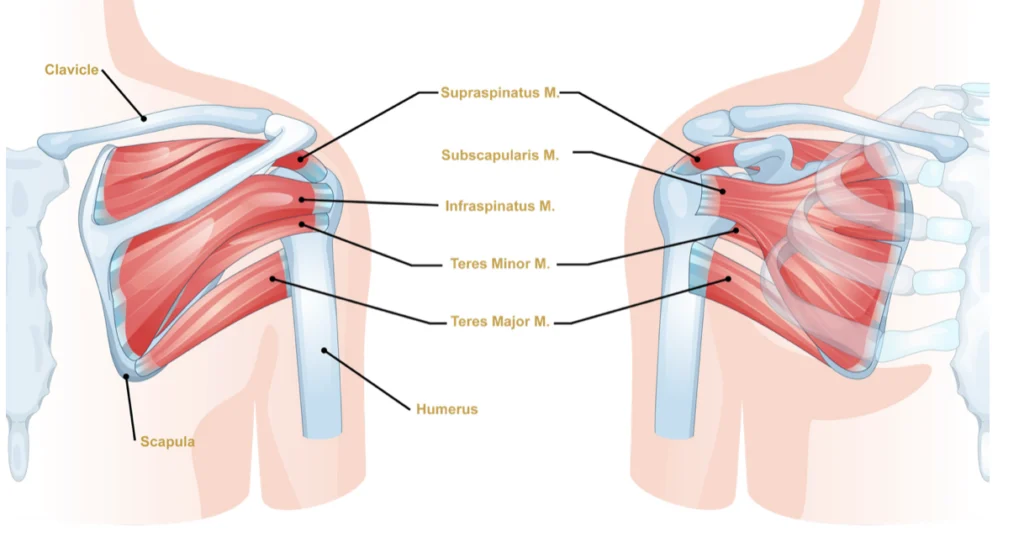
Before diving into the differences between a rotator cuff tear vs strain, it helps to understand what the rotator cuff actually is. The rotator cuff is a group of four muscles and their associated tendons. These tendons wrap around the head of the upper arm bone, called the humerus, and anchor into the shoulder blade. Together, they work to stabilize the shoulder joint and control the movement of your arm.
The four muscles are the supraspinatus, infraspinatus, teres minor, and subscapularis. Each one plays a specific role. The supraspinatus helps you lift your arm out to the side. The infraspinatus and teres minor handle external rotation, and the subscapularis manages internal rotation. When any part of this system becomes damaged, even to a minor degree, the entire shoulder can feel off.
What Is a Rotator Cuff Strain?
A strain refers to an injury involving the muscle fibers or the muscle-tendon junction. When the shoulder is placed under sudden or excessive force, the tissue can overstretch or develop small micro-tears within the muscle fibers themselves. This is generally considered less severe than a full rotator cuff tear, but it still causes real pain and can limit your function if left untreated.
Rotator cuff strains are commonly graded on a scale from mild to severe:
- Grade 1 (Mild): The tissue is overstretched, but there’s minimal tearing. You might feel some soreness and tenderness, but strength is typically preserved.
- Grade 2 (Moderate): There is partial tearing of the muscle fibers. You may experience more significant pain, some swelling, and a noticeable reduction in strength.
- Grade 3 (Severe): This involves a near-complete or complete disruption of the muscle, which starts to overlap with what we’d consider a tear.
Strains often result from acute overload, like lifting something heavy in an awkward position, or making a sudden throwing motion. They can also develop gradually through repetitive overhead activity, where the muscle gets repeatedly stressed over time without adequate recovery. Athletes in sports like baseball, tennis, and swimming are particularly prone to this type of overuse strain.
The pain from a strain tends to feel like a dull, achy soreness. It’s usually worse with movement and better with rest. You may notice some stiffness in the morning or discomfort when reaching overhead. Swelling can occur, and the area may be tender to the touch.
What Is a Rotator Cuff Tear?
A rotator cuff tear involves damage specifically to the tendon, the thick, fibrous cord that connects the muscle to the bone. Tears can range from partial, where the tendon is frayed or partially disrupted, to full-thickness, where the tendon has completely separated from its attachment on the humerus.
Tears are generally divided into two main categories based on how they occur.
Acute Tears
Acute tears happen suddenly, usually as the result of a specific traumatic event. Falling onto an outstretched arm, catching yourself from a fall, or lifting a heavy object with a jerking motion can all cause an acute tear. These injuries tend to produce immediate, sharp pain and a rapid loss of function. Some patients describe hearing or feeling a “pop” at the time of injury.
Degenerative Tears
Degenerative tears develop gradually over years, typically related to the natural aging process and cumulative wear and tear on the tendon. Blood supply to the tendons usually decreases with age, which can impair the tissue’s ability to repair minor damage over time. These tears often begin as partial tears and slowly progress. You may notice the pain building slowly, becoming more persistent and difficult to ignore.
Compared to a strain, a tear tends to cause more pronounced symptoms. Significant weakness is a common sign. Many patients find it difficult or impossible to lift their arm above shoulder height or notice that the arm gives out partway through a movement. Night pain is another common complaint. Lying on the affected shoulder can be extremely uncomfortable, and many patients find their sleep disrupted as a result.
Rotator Cuff Tear vs Strain: Breaking Down the Key Differences
While both conditions affect the same general area of the shoulder, there are some meaningful differences that can help distinguish one from the other. That said, it’s worth noting that the two can’t always be told apart based on symptoms alone.
Pain character: Strains tend to produce a more diffuse, achy discomfort. Tears, especially full-thickness tears, may produce sharper pain, particularly during specific movements or at rest.
Weakness: A rotator cuff strain may cause some discomfort with resisted movement, but persistent weakness is more characteristic of a tear. If you find yourself unable to lift your arm or hold it up against even light resistance, a tear may be more likely.
Onset: Strains may follow a recognizable event, and symptoms may improve with rest within days to weeks, though recovery patterns vary. Tears, particularly degenerative ones, may seem to come on without a clear cause, or persist well beyond what you’d expect from a simple strain.
Night pain: While both conditions can cause discomfort, persistent night pain that interferes with sleep tends to be more associated with rotator cuff tears than strains.
How Is Each Condition Diagnosed?
When a patient comes in with shoulder pain, I start with a thorough history and physical examination. I’ll ask about how the pain started, what makes it better or worse, and whether there’s any weakness or loss of motion. I’ll also perform a series of specific tests designed to assess the individual tendons and identify areas of pain or weakness.
From there, imaging helps confirm the diagnosis. An X-ray can rule out bony problems like fractures or arthritis, but it doesn’t show soft tissue directly. To evaluate the rotator cuff, an MRI is typically the preferred imaging tool. It can reveal whether the tendon is intact, partially torn, or fully torn, and can also identify the degree of muscle involvement. In some situations, an ultrasound may be used as well.
Treatment Approaches
For Strains
For strains, rest and activity modification are typically the first step. This doesn’t necessarily mean complete immobilization, but rather avoiding the specific activities that provoke pain. Ice and anti-inflammatory medications may help manage discomfort during the early phase. As symptoms settle, physical therapy usually plays a central role in recovery. A targeted program can help restore flexibility, rebuild strength around the shoulder, and correct any movement patterns that may have contributed to the strain in the first place. In some cases, regenerative medicine options, such as platelet-rich plasma (PRP), may also be worth discussing for patients looking to support the healing process more actively.
For Tears
Treatment for a rotator cuff tear depends on several factors: the size and location of the tear, the patient’s age, activity level, overall health, and how much the injury is affecting daily function.
Many partial tears and even some smaller full-thickness tears can be managed without surgery, at least initially. Physical therapy may help strengthen the surrounding muscles to compensate for the damaged tendon, which can meaningfully reduce pain and improve function. Anti-inflammatory treatment and PRP injections may also play a supporting role in this approach.
Larger tears, acute traumatic tears in active patients, or tears that have not responded to conservative treatment may be better addressed surgically. Rotator cuff repair is typically performed arthroscopically, meaning through small incisions, with a camera and specialized instruments.
It’s important to understand that surgery is not the automatic answer for every tear. These decisions are best made collaboratively, taking into account the full picture of an individual’s goals and health.
When Should You See a Specialist?
If you’ve strained your shoulder and symptoms improve steadily over one to two weeks with rest, you may be on the right track. But certain signs suggest that a more thorough evaluation from an experienced shoulder specialist may be worthwhile.
You may want to consider scheduling an appointment if you notice any of the following:
- Pain that is not improving, or is getting worse, after a week or two of rest
- Significant weakness when trying to lift your arm or rotate it
- Difficulty sleeping due to shoulder pain
- A popping or snapping sensation at the time of injury
- Pain that came on suddenly following a fall or traumatic event
Summary
The question of rotator cuff tear vs strain is one that many patients wrestle with, and understandably so. Both conditions can cause real shoulder pain that interferes with daily life. A strain involves overstretching or micro-tearing within the muscle tissue, typically causes aching discomfort, and often responds well to conservative care. A tear involves more significant tendon disruption, tends to produce more pronounced weakness and persistent pain, and may require a more involved treatment approach depending on its severity. While symptoms can offer some clues, an accurate diagnosis generally requires a proper physical examination and imaging. If your shoulder pain isn’t following the typical path of a minor strain, it may be worth getting a closer look.
Frequently Asked Questions
Can a rotator cuff strain turn into a tear?
It’s possible. A strain that is not properly rested and rehabilitated can place additional stress on already compromised tissue. Over time, particularly with repetitive overhead activity or continued use through pain, ongoing stress on the shoulder may contribute to further tissue injury, although not all strains progress to tears.
How long does a rotator cuff strain typically take to heal?
Recovery time can vary depending on the severity of the strain. Mild strains may settle down within one to two weeks with rest and basic care. Moderate strains often take four to six weeks or more, particularly if physical therapy is needed to restore full strength and flexibility. More severe strains may take several months.
Can regenerative medicine treatments help with rotator cuff injuries?
Regenerative medicine options, such as platelet-rich plasma (PRP) therapy, may be a helpful part of the treatment plan for select patients with rotator cuff strains or partial tears. These approaches aim to support the body’s natural healing processes by concentrating growth factors and delivering them directly to the injured tissue. They may be particularly worth exploring for patients who are looking for alternatives to surgery or who want to support recovery alongside physical therapy.